
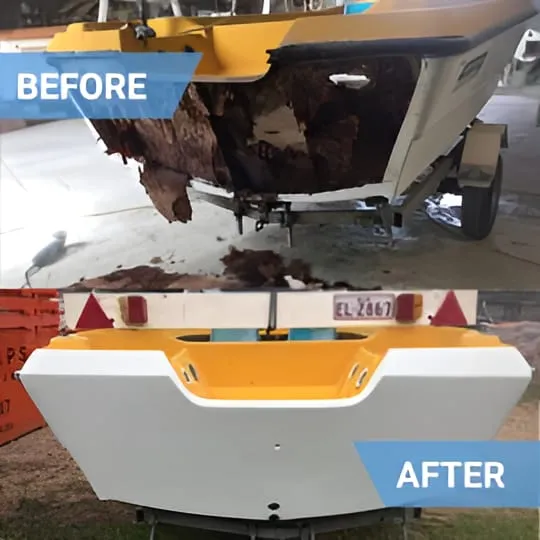
Transom repairs are led by Harry, our lead boat builder — a composite specialist with 20 years of hands-on experience in structural transom rebuilds, including foam-core installations and full fibreglass lamination. Harry inspects every transom personally before quoting: he'll tell you whether the job is a partial repair, a full rebuild, or somewhere in between, and why.
What Is the Transom?
The transom is the structural panel at the stern (rear) of your boat. It is where the outboard motor mounts — which means it bears the full thrust load of the engine every time you accelerate. On fibreglass boats, the transom is typically a sandwich construction: fibreglass skins over a timber (usually marine plywood) or foam core. The core gives the transom its rigidity and load-bearing capacity. Transom failure is one of the most common structural problems on older fibreglass boats — particularly those built between the 1970s and early 2000s with marine plywood cores, which are vulnerable to water ingress through unsealed fittings and motor bolt holes. A compromised transom is one of the most serious structural failures a fibreglass boat can develop — it directly affects the safety and handling of the vessel under power, and if left unaddressed can lead to complete motor loss under hard acceleration. Full transom rebuilds start from $6,500 for complete removal and reconstruction, depending on vessel size.
How Do You Know If Your Transom Needs Repair?
Transom failure is one of the most common structural problems on older fibreglass boats, particularly those built with timber cores. Watch for these warning signs:
- Sponginess or flex — the transom feels soft or bouncy when you push on it with your hand
- Motor movement — your outboard rocks or tilts under load in a way it didn't previously
- Water in the bilge — transom delamination and water ingress often presents as unexplained bilge water
- Cracking around motor mounts — stress cracks radiating from the motor bracket holes
- Visible delamination — the fibreglass skin separating from the core, visible as bubbling or lifting on the surface
- Discolouration — dark staining in the fibreglass around the transom, particularly around fittings and drain holes
Do not ignore a soft transom. A compromised transom can lead to sudden motor loss — in extreme cases, the transom can fail under hard acceleration, taking the motor with it. This is a genuine safety risk.
How Does the Transom Repair Process Work?
- Inspection and assessment — we tap-test and probe the transom to map the extent of saturation and delamination before quoting
- Remove motor and hardware — motor bracket, trim tabs, bilge plugs, and any fittings are removed
- Cut out damaged sections — the fibreglass inner skin is carefully cut open to access the saturated core
- Core removal and drying — saturated timber or foam is removed; the remaining fibreglass structure is dried thoroughly before new core material is fitted
- New core installation — marine-grade plywood or high-density foam (depending on specification) is fitted, bonded, and sealed
- Re-lamination — biaxial fibreglass cloth and vinylester or epoxy resin is used to re-glass the inner skin, building back to original specification or better
- Outer skin fairing and refinishing — the exterior is faired, primed, and finished to match the existing hull
- Hardware reinstallation — all fittings reinstalled and tested
How Long Does a Transom Repair Take?
A straightforward transom repair (partial core replacement, no structural complications) typically takes 5–7 business days. A full transom rebuild on a larger vessel with extensive delamination may take 8–14 business days. We assess each transom individually and provide an accurate timeframe before commencing work.
What Is the Difference Between Timber Core and Foam Core Transoms?
Many boats built from the 1970s to the early 2000s used marine plywood as the transom core. Plywood is strong and relatively cheap, but it is vulnerable to water ingress — once moisture penetrates, rot begins quickly. Modern fibreglass boats increasingly use closed-cell foam cores, which cannot rot and are impervious to water. We can replace a failing plywood core with a foam equivalent during a rebuild, which improves long-term durability significantly.
How Much Does Transom Repair Cost in Melbourne?
Transom repair pricing depends on the extent of the damage, the vessel size, and the core material specified. The table below gives indicative pricing for common repair scenarios.
| Repair Type | Typical Cost | Timeframe | Suitable For |
|---|---|---|---|
| Partial transom repair | From $2,500 | 5–7 business days | Localised core damage on small runabouts |
| Full transom rebuild (plywood core) | From $6,500 | 8–14 business days | Complete removal and reconstruction |
| Full rebuild with foam core upgrade | From $7,500+ | 8–14 business days | Rot-proof upgrade, long-term durability |
Every transom is inspected and quoted individually before work begins — no surprises. Core material choice (marine plywood vs high-density foam) affects cost; we advise on the best option for your vessel and budget.
Why Are Transom Repairs Common on Port Phillip Bay Boats?
A significant proportion of the transom repairs we carry out are on boats that have been on Port Phillip Bay moorings or marina berths for many years. The Bay's conditions — warm, salty water and high UV exposure — accelerate the deterioration of unsealed transom fittings and motor bracket fixings. Many boats built before the mid-2000s have marine plywood transom cores that have been slowly absorbing moisture for a decade or more before symptoms become obvious. If your boat has been moored at Mordialloc, Chelsea, Frankston, or any other Bay marina, and your transom is showing any softness, it is worth an assessment before the next season.
Do You Offer Standalone Gelcoat Repairs?
Yes. While gelcoat repair is part of most structural transom work, we also carry out standalone gelcoat repairs on transoms and surrounding hull surfaces. Common standalone gelcoat jobs include repairing chips and cracks around motor bracket bolt holes, filling stress crazing on the transom face, and restoring gelcoat where previous repairs have discoloured or cracked. These repairs are typically completed in 1–3 business days depending on the extent of damage and curing time required.
Do You Handle Insurance Claim Repairs?
Yes. Transom damage from impacts, structural failure, or long-term water intrusion is often insured, and we work these claims frequently. We don't lodge the claim for you (that stays between you and your insurer), but once you've got a claim number we take over communication with the assessor — quotes, progress updates, and all the paperwork sit with us.
How Do You Book a Transom Assessment?
If you suspect your transom has an issue, bring your vessel to our Braeside workshop for an assessment. We'll tell you honestly what the repair involves and what it will cost before you commit to anything.
In many cases, boats presenting for transom assessment also have associated deterioration in the floor panels or stringer system — we inspect adjacent structure as standard practice during every transom assessment.
Located at JV Marine World, 878 Springvale Road, Braeside VIC 3195. We serve all Melbourne suburbs.
Want to learn the warning signs of transom rot before bringing your boat in? Read our guide: 7 warning signs your transom is rotting.