
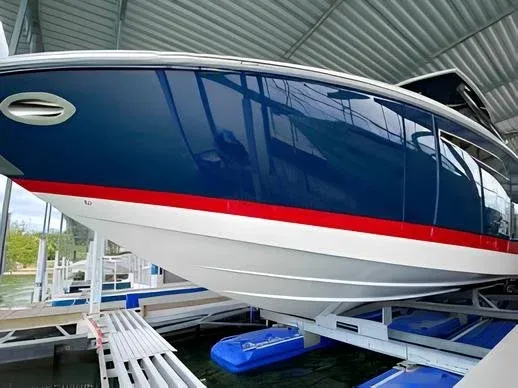
Our detailing work is carried out under Harry, our lead boat builder with 20 years of experience. Harry has hands-on experience with gelcoat restoration, compounding, and polishing — and knows when a faded hull can be recovered with machine work and when it has gone past the point where detailing alone will fix it. Honest advice before you spend money.
What Is Professional Boat Detailing?
Boat detailing is the process of restoring and protecting a vessel's fibreglass gelcoat finish to the highest achievable condition. Unlike a basic wash, professional detailing involves a systematic sequence of paint correction steps — cleaning, decontaminating, cutting, polishing, and protecting — carried out with machine polishers and marine-grade compounds. The result is a finish that looks substantially better and is protected against the UV, salt, and moisture exposure that degrades gelcoat over time. In Melbourne's climate, the combination of intense summer UV and Port Phillip Bay salt spray accelerates gelcoat oxidation significantly — a professionally detailed and protected hull will maintain its finish far longer than an unprotected one. Detailing typically starts from $1,000 for professional cleaning, polishing, and finishing, with larger vessels ranging up to $2,500 for a full multi-stage compound and sealant treatment.
Gelcoat is the pigmented outer skin of a fibreglass boat — it is not paint, and it behaves differently under mechanical polishing. It is thicker than automotive paint but can be consumed by aggressive cutting if done without care. Our detailing process is calibrated specifically for marine gelcoat, not adapted from car detailing protocols.
How Do You Identify Gelcoat Oxidation?
Oxidation is the most common cosmetic problem on fibreglass boats in the Australian marine environment. Exposure to UV radiation breaks down the polymers in the gelcoat surface, causing it to become chalky, dull, and porous. The characteristic signs are:
- Chalky or powdery surface — wipe a white cloth across the hull; if white residue transfers, the gelcoat is oxidising
- Flat, dull appearance — the reflective gloss that new gelcoat has disappears as oxidation progresses
- Faded colour — coloured hulls lose vibrancy; white hulls take on a yellow or grey cast
- Rough texture — the surface feels slightly gritty or rough rather than smooth
- Watermarks that don't wipe off — hard water deposits and salt staining are harder to remove from oxidised gelcoat
Light to moderate oxidation is fully reversible with machine compounding and polishing. Heavy oxidation — where the gelcoat has degraded beyond recoverable depth — may require gelcoat respray or fairing in the worst-affected areas.
How Does the Boat Detailing Process Work?
- Pre-wash and decontamination — thorough hand wash to remove salt, algae, and surface contamination; clay bar treatment to remove embedded contaminants from the gelcoat
- Surface assessment — inspect the hull in direct light to identify oxidation severity, scratches, swirl marks, and any areas requiring special attention
- Machine compounding — where oxidation is present, a medium or heavy-cut compound is applied with a machine polisher to remove the degraded gelcoat layer and expose fresh material beneath
- Machine polishing — a finer polish refines the surface, removing compounding marks and bringing up the gloss level
- Gloss enhancement — where appropriate, a finishing polish or glaze is applied to maximise depth and clarity of the finish
- Protection application — a marine-grade carnauba wax or polymer sealant is applied to protect the restored surface from UV and environmental exposure
- Detail finishing — rubbers, plastics, stainless fittings, and glass are dressed and cleaned to complete the overall presentation
How Often Should You Have Your Boat Detailed?
For boats kept on swing moorings or in marina berths exposed to year-round sun, we recommend a full machine polish annually, with a wax top-up coat halfway through the season. The UV load in Melbourne's summer months (November to March) is significant, and gelcoat that is left unprotected during this period oxidises faster than at any other time of year.
Trailered boats that are stored under cover between uses have a longer maintenance interval — typically a full detail every two to three years, with a wax application each season. Even stored vessels benefit from a protective coat before the summer boating season begins.
Can You Combine Detailing With Repairs?
Boat detailing is most effective when the hull is structurally sound and free of chips, scratches, osmotic blisters, and damaged gelcoat. We commonly combine detailing with antifouling or minor gelcoat repair — filling small chips and scratches, blending the repair, and then carrying out the full polish sequence — so that the finished result is completely consistent across the hull surface.
If your hull has more extensive damage (deep scratches, impact damage, delamination, or osmotic blistering), we will identify this during the initial inspection and quote for repairs ahead of or alongside the detailing work.
What Results Can You Expect From Gelcoat Restoration?
Gelcoat restoration on a heavily oxidised boat is one of the most dramatic improvements we achieve. A hull that looks old, chalky, and faded can be returned to a high-gloss finish that closely matches the original factory appearance. The improvement is most visible on dark or coloured hulls where oxidation has bleached the colour significantly — but even white-hulled vessels show a striking difference between a flat, chalky surface and a freshly polished, reflective finish.
How Much Does Boat Detailing Cost in Melbourne?
Detailing pricing depends on the vessel's length, the severity of oxidation, and the level of work required.
| Vessel Size | Typical Cost | Includes |
|---|---|---|
| Small runabout (up to 5m) | From $1,000 | Professional cleaning, polishing, and finishing |
| Mid-size boat (5–7m) | $1,000–$1,500 | Compound, polish, sealant, two-stage correction |
| Cabin cruiser / larger (7m+) | $1,500–$2,500 | Full compound, multi-stage polish, ceramic or wax sealant |
Minor gelcoat chip and scratch repairs can be combined with the detail — these are quoted separately before work begins. We inspect every vessel before quoting and provide a fixed price — no open-ended labour rates.
Why Do Port Phillip Bay Boats Need Regular Detailing?
Melbourne's UV load and Port Phillip Bay's salt spray environment are hard on fibreglass gelcoat. Boats kept on bay moorings or in marina berths at Mordialloc, Chelsea, Frankston, or Mornington are exposed to some of the most intense oxidising conditions in Victoria — particularly between November and March. A boat that is polished and protected at the start of summer will hold its finish through the season far better than one that is left bare. If your hull is already showing chalking or colour fade, machine compounding can recover the majority of the loss before it reaches the point where respray is the only option.
Why Choose Boat Repairs Melbourne for Detailing?
Boat detailing in Melbourne is a competitive market with a mix of mobile detailers, car detailers branching out, and marine specialists. We sit firmly in the marine-specialist category, and four things distinguish our work:
- 20 years of fibreglass experience. Detailing here is led by Harry, our lead boat builder. He understands gelcoat as a structural material, not just a cosmetic finish — which means he won't push aggressive cutting on a hull that cannot sustain it.
- Marine compounds and pads, not automotive. Gelcoat behaves differently to automotive clear-coat under polishing. We use marine-specific cutting compounds, finishing polishes, and wool/foam pads calibrated for fibreglass. Adapted automotive products will give a glossy short-term result and burn through gelcoat in the wrong hands.
- Workshop-based, not parking-lot mobile. Our work is carried out under cover at our Braeside workshop. That means consistent lighting for surface assessment, controlled temperature for sealant cure, and no dust or contamination during polishing — none of which is possible in a customer's driveway.
- Honest assessment before you commit. We will tell you when machine polishing alone will not recover the surface and when respray is the better option. You get the real answer in the inspection, not after we have already cut into the gelcoat.
What Is the Difference Between Ceramic Coating and Wax?
Wax (typically carnauba or polymer-based) sits on the surface as a sacrificial protective layer. It looks great immediately and is cheap to apply, but in Melbourne's UV and salt environment it lasts 3–6 months before re-application is needed. Ceramic coating, by contrast, chemically bonds to the gelcoat and creates a hardened, hydrophobic surface that lasts 12–24 months — sometimes longer on lightly-used vessels. Ceramic costs more upfront but works out cheaper per year of protection, and gives a noticeably deeper gloss.
The choice depends on how your boat is stored and used. Vessels kept under cover or only seeing seasonal use are well served by an annual wax. Boats moored on Port Phillip Bay year-round, exposed to constant salt spray and UV, get far better value from ceramic. We will recommend the right option after inspecting the hull — there is no advantage to selling you the more expensive treatment if it will not return the value.
Do You Offer Ceramic Coating for Boats?
Yes. We offer marine ceramic coating as a premium protective finish for fibreglass boats. Ceramic coating creates a durable, hydrophobic layer over the gelcoat that repels water, UV, salt spray, and contaminants — providing significantly longer-lasting protection than traditional wax or polymer sealant. A properly applied ceramic coating can last 12–24 months depending on exposure conditions, compared to 3–6 months for a standard wax.
Ceramic coating is applied after thorough compounding and polishing — the surface must be fully corrected before the coating goes on, as it locks in whatever condition the gelcoat is in. We recommend ceramic coating for boat owners who want the best possible finish with the least ongoing maintenance. It is particularly suited to boats kept in Port Phillip Bay marinas or on swing moorings, where salt and UV exposure are constant.
Do You Offer Standalone Cut and Polish?
Yes. We offer standalone cut and polish for boat owners who want their hull and topsides restored without a full detail package. A cut and polish involves machine compounding to remove oxidation, followed by a high-gloss polish to restore the gelcoat's original depth and shine. This is the right option if your boat's gelcoat is faded or chalky but does not need interior cleaning, hardware polishing, or other full-detail work.
We use professional-grade marine compounds and polishing pads designed for gelcoat — not automotive products. The result is a smooth, reflective finish that resists contamination and is ready for wax or ceramic coating. Call us for a standalone polish quote — many boat owners combine this with antifouling before the season starts.
Can You Remove Water Stains from Marine Glass and Windows?
Yes — marine glass stain removal is part of our detailing work. Hard-water spotting, salt etching and mineral deposits build up on windscreens, side glass, clears and cabin windows faster on Port Phillip Bay than most owners expect, because spray dries on the surface and leaves the dissolved salts and minerals behind. Left long enough, those deposits bond to the glass and stop coming off with normal washing.
What is achievable depends on how far the staining has progressed:
- Surface mineral deposits and salt film — remove cleanly with marine-grade glass cleaners and a decontamination pass. Full clarity restored.
- Bonded hard-water spotting — needs a mild acidic treatment or machine polishing with a glass-specific compound. Usually restores clarity, sometimes with faint residual marking.
- Etched glass — where minerals have physically pitted the surface, polishing improves it but cannot always fully reverse it. We will tell you honestly what we expect to achieve before starting.
Acrylic and polycarbonate clears are treated differently again — they scratch far more easily than glass, so they need plastic-specific polishes rather than the compounds used on windscreens. Using the wrong product on clears is the most common way owners permanently haze them.
Glass and clears are included in our full detailing packages. We also handle glass stain removal as a standalone job if the rest of the vessel does not need attention — call 0475 790 642 and describe what you are seeing. Applying a protective coating afterwards, as with general gelcoat maintenance, slows the deposits re-forming.
Do You Handle Insurance Claim Repairs?
Yes. We regularly handle insurance jobs for cosmetic damage — gelcoat scrapes from docking, impact chips, and storm damage. You lodge the claim; once you send us the claim number, we liaise directly with your insurer through the repair and handle the paperwork from that point on.
How Do You Book a Detailing Assessment?
Bring your vessel to our Braeside workshop for an inspection and quote. We'll assess your hull's current condition, confirm what is achievable, and provide a fixed price before any work begins.
Located at JV Marine World, 878 Springvale Road, Braeside VIC 3195. Call 0475 790 642 or email info@boatrepairsmelbourne.com.au.