
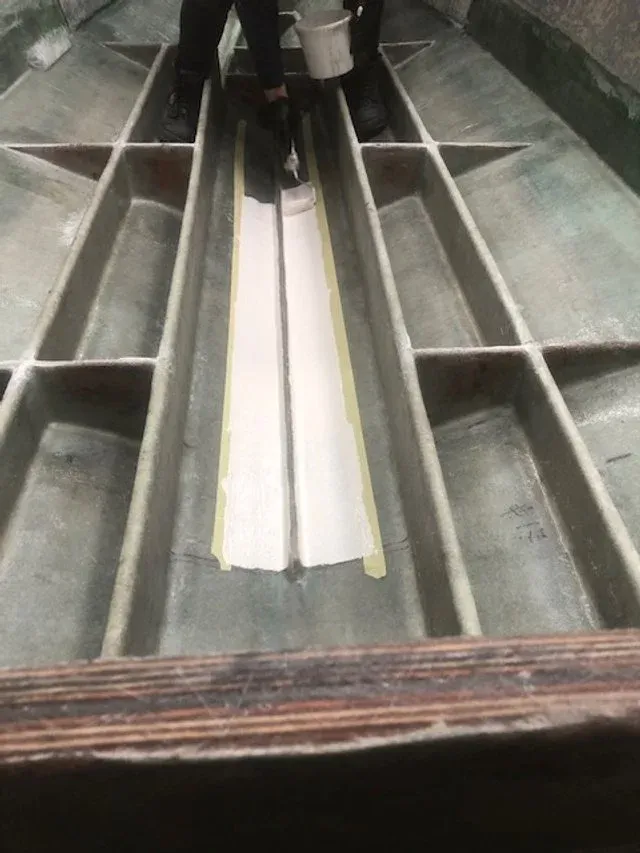
Stringer repair work at our Braeside workshop is carried out by Harry, our lead boat builder with 20 years of experience. Stringer jobs are among the most technically demanding fibreglass repairs — they involve removing the boat's internal structure, assessing the full extent of rot or delamination, and rebuilding to a standard that matches or exceeds the original factory lamination. Harry has the composite background to do that properly.
What Are Boat Stringers?
Stringers are the internal longitudinal structural members that run fore and aft (front to back) inside a fibreglass boat hull. They sit on the hull's inner skin and support the floor panels, fuel tanks, and other internal components. Think of stringers as the backbone of your boat's interior structure — they give the hull its rigidity and allow it to withstand the flex and impact loads of running at speed on the water. Stringer failure is one of the most common structural problems on older fibreglass boats, particularly those built with timber cores that are vulnerable to water ingress through unsealed bilge fittings. Stringer replacement is a major structural repair starting from $10,000, depending on the number of stringers affected and the vessel size.
On fibreglass boats, stringers are typically constructed as fibreglass shells over a foam or timber core. The fibreglass encapsulates the core and bonds to the hull, creating a strong, integrated structure. When the encapsulation fails — due to impact damage, water ingress through unsealed fittings, or simply age — the core begins to saturate, rot (in the case of timber cores), or delaminate.
How Do You Know If Your Boat Stringers Need Repair?
- Hull flexing — the hull twists or flexes noticeably more than it used to when running at speed
- Cracking or popping sounds — audible stress sounds from the bilge area when the hull flexes
- Soft spots — pressing on the floor or the sides of the bilge reveals areas that flex or give way
- Visible delamination — the fibreglass skin of the stringer is lifting or bubbling away from the core
- Standing water that doesn't drain — can indicate stringer failure creating low spots or blocking drain paths
- Loose floor panels — floor panels no longer sit solidly because the stringers they rest on have lost rigidity
- Visual rot or discolouration in the bilge — dark staining or wet-looking fibreglass that never dries fully
Stringer failure is a structural safety issue. A boat with compromised stringers is at risk of catastrophic hull failure under hard running conditions. If you notice any of these signs, have the boat inspected promptly.
What Causes Stringer Damage in Fibreglass Boats?
The most common cause of stringer damage is water ingress. Water enters through unsealed bilge fittings, drain plugs, floor screws, or impact damage to the hull. Once inside the fibreglass-encapsulated stringer, moisture can saturate a foam core or cause a timber core to rot. As the core degrades, the fibreglass skin loses its structural support and begins to delaminate. This process is typically slow, often developing over years before symptoms become obvious.
How Does the Stringer Repair Process Work?
- Inspection — tap-testing and probing to identify the extent of delamination and saturation throughout the stringer system
- Floor panel removal — access panels or full floor panels are removed to expose the stringers
- Fibreglass skin removal — damaged sections of the fibreglass skin are cut away to expose the core
- Core removal and drying — saturated foam or rotted timber is removed; the area is dried thoroughly before new material is installed
- New core installation — high-density foam or marine-grade plywood is fitted and bonded in place
- Re-lamination — the stringer is re-glassed using biaxial fibreglass cloth and vinylester or epoxy resin, bonded to the hull skin
- Floor reinstatement — floor panels are refitted, sealed, and secured
Can You Prevent Stringer Damage?
Yes — the most effective prevention is ensuring all deck and bilge penetrations (screws, drain plugs, fittings) are properly bedded and sealed. Any fitting that penetrates the floor or bilge should be sealed with a quality marine bedding compound to prevent water tracking down into the stringer system. Keeping the bilge dry and checking periodically for soft spots or unusual flex is the best long-term maintenance practice.
How Much Does Stringer Repair Cost in Melbourne?
Stringer repair pricing varies based on the number of stringers affected, the extent of saturation, and whether floor panels need replacement at the same time.
| Repair Type | Typical Cost | Timeframe | Suitable For |
|---|---|---|---|
| Stringer removal and replacement | From $10,000 | 8–12 business days | Removal and replacement of deteriorated or damaged stringers |
| Full stringer system rebuild | From $15,000+ | 10–15 business days | Complete system, full floor removal and reinstatement |
We always quote before commencing — the inspection includes a full assessment of the floor and adjacent structure so there are no surprises mid-job.
Why Is Stringer Damage Common on Port Phillip Bay Boats?
Stringer deterioration is common in the older boat population on Port Phillip Bay. The combination of years in salty water, vibration from running at speed across Bay chop, and the typical history of unsealed bilge fittings on boats from the 1990s and early 2000s creates ideal conditions for stringer water ingress. If your boat flexes noticeably at speed or sounds different underfoot compared to a few seasons ago, a stringer inspection is warranted. Our workshop at Braeside is centrally located for boat owners from Mordialloc to Mornington.
Do You Handle Insurance Claim Repairs?
Yes — stringer repairs are often insured, particularly when the cause is impact damage, grounding, or a major water ingress event. Lodgement is your job; the rest is ours. Once we have your claim number we liaise directly with your insurer for quotes, assessor visits, progress updates, and completion sign-off.
How Do You Book a Stringer Assessment in Melbourne?
If you're concerned about your boat's stringers, bring it to our Braeside workshop for an inspection. We'll assess the extent of any damage and give you a clear, honest quote before any work begins.
Stringer deterioration frequently co-occurs with floor panel damage — the two systems are physically connected, and we assess both whenever either is under inspection. If you suspect your transom may also be involved, we assess that at the same time.
JV Marine World, 878 Springvale Road, Braeside VIC 3195. Call 0475 790 642.