
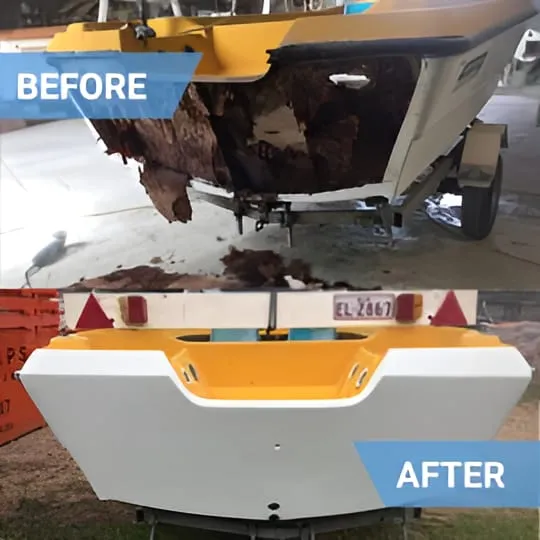
If you've owned your fibreglass boat for ten years or more, there's a good chance your transom is starting to tell you something. Most owners don't listen until it's too late — until the outboard starts drooping, or the boat flexes under power, or worse, a bolt pulls through on the bay. By then, a $2,500 partial repair has often become a $7,500-plus foam-core rebuild.
The good news: transom rot gives you warning signs. If you know what to look for, you can catch it early, plan the repair, and avoid the emergency.
This is the rundown I wish every boat owner got when they bought a used boat.
What is a transom — and why does it rot?
Your transom is the vertical panel at the back of your boat that holds the outboard motor. On a fibreglass boat, it isn't solid fibreglass. It's a sandwich: fibreglass skin on the outside, a plywood or foam core in the middle, fibreglass skin on the inside. That core is what gives the transom its stiffness — strong enough to carry a 150 HP outboard through a three-foot chop for thousands of hours.
Plywood cores have been the industry standard for decades. Marine-grade ply is tough, stiff, and cheap. But it has one fatal flaw: if water gets into it, it rots.
And water always finds a way in.
Every hole you've ever drilled in your transom — for the outboard mounting bolts, for a transducer bracket, for trim tabs, for a stainless ladder — is a potential entry point. Over years, the sealant breaks down. Vibration works bolts loose. UV degrades the fibreglass around the screw heads. Water seeps past the seal, into the plywood core, and starts a slow decay that you can't see from the outside.
By the time visible signs appear, the rot has usually been working for years.
The 7 warning signs you can check yourself
You don't need any special tools to run through most of these — just a torch, a small screwdriver, and about fifteen minutes. If you find any of them, don't panic, but do get the transom inspected.
1. A soft or spongy feel around the engine mount
Press your palm firmly against the transom, right next to the outboard bolts. Then do the same a foot or so away from the bolts, out toward the edges. A healthy transom should feel rigid — like pressing against solid concrete. If you can feel any give, any slight sponginess, or any difference between the bolt area and the rest of the transom, you're almost certainly looking at rot starting around those bolt holes. This is the single most reliable sign, and nine times out of ten it's the first one owners notice.
2. Star cracks radiating out from bolt holes
Get down at eye level and look closely at the fibreglass around each outboard mounting bolt. Are there fine cracks spreading outward like the points of a star? Star cracks happen when the core beneath the fibreglass has lost its support — the skin flexes under load without anything holding it rigid, and the gel coat starts to fracture. You might also see them around transducer mounts, trim tab bolts, or ladder attachment points. Small individual cracks around one bolt can be superficial. Cracks around multiple bolts, or cracks that extend more than a few centimetres, almost always mean core damage.
3. Water weeping from the transom or hull joint
Check your transom after the boat's been out on a trailer for a day in the sun, or after a wash-down. Look along the bottom edge of the transom, where it meets the hull, and at the corners where the transom meets the gunwales. Are there damp spots that shouldn't be there? Does water keep appearing even when the boat's been dry for hours? That's water trapped inside the core coming back out under heat or pressure. A healthy transom doesn't weep.
4. Rust staining around screws and bolts
Even stainless fasteners can discolour if they're sitting in saturated wood. Look for rust-coloured streaks running down the fibreglass below any bolt or screw head on the transom. That stain is iron (from the fastener) and tannin (from wet plywood) leaching out together. It's a very clear marker that water is sitting in the core around that fastener, and that the core is rotting.
5. Flex or movement under outboard weight
This one's easier to test on the trailer than on the water. Have a mate lift and push down gently on the leg of your outboard, in line with its swing. A healthy transom should feel like you're pushing against the whole boat — zero transom movement independent of the hull. If you can see the transom itself flexing or twisting separately from the rest of the boat, especially side-to-side, the core has failed and the outboard is only being held in place by the fibreglass skins and the bolts. That's dangerous — it's the state just before a catastrophic failure.
6. A hollow sound when you tap along the transom
This is the old boatbuilder's trick. Take the handle of a screwdriver — not the metal end, the plastic handle — and tap firmly along the transom in a grid pattern. Start at the top corners and work your way down. Tap every 10 cm or so. A healthy, solid transom gives you a short, firm, high-pitched tick. A rotten section gives you a lower, duller thud or thunk. The difference is obvious once you've heard both. Any area that sounds hollow or dead needs investigation.
7. A misaligned, drooping, or vibrating outboard
Stand directly behind the boat with the motor down. The outboard should sit perfectly square to the transom, centred, vertical. If it's leaning to one side, or if the whole motor is drooping lower than it used to, the transom is no longer holding the bolts rigidly — the core beneath them has compressed. Similarly, if your outboard has developed a new vibration under power that didn't used to be there, a soft transom is one of the first things I'd check.
The DIY screwdriver test (use with care)
If you've found any of the above signs, there's one more test that confirms the diagnosis — but it involves putting a small hole in your transom, and if it's already compromised, you don't want to make it worse. Better to let a workshop do it.
If you still want to try it: pick an inconspicuous spot low on the transom, inside the boat where it's hidden. With a 3 mm drill bit, carefully drill in about 5 mm — just enough to get past the inner skin and into the core. Withdraw the bit and look at it. Dry, clean wood fibres? You're probably fine. Damp, dark, crumbly material — or worse, no resistance because the bit went straight through mush? You've got rot, and the repair should happen before your next season on the water. Whatever you find, fill the test hole immediately with marine-grade epoxy. Don't leave it open.
What happens if you ignore it?
I've seen three failure modes — all avoidable, all expensive.
The slow version: rot spreads, the transom softens progressively, your outboard alignment goes out of spec, fuel economy drops, performance drops, and eventually the bolts start pulling through the fibreglass. Cost: typically a full transom rebuild at $6,500+, often combined with other repairs because the damage has moved into adjacent areas. Resale value: destroyed.
The fast version: the transom fails under load, on the water, with the motor running. Usually this happens in rough weather or when the boat's heavily loaded. The outboard partially detaches from the hull, held on only by the steering cables. If you're lucky, you limp home.
The insurance version: a bolt pulls through at launch or on the trailer. Most comprehensive policies will replace the motor, but cover for underlying transom rot is rare — most insurers class it as wear and tear.
Catching rot early turns a catastrophic failure into a planned workshop job.
Partial repair vs full transom rebuild
If the rot is caught early, a partial rebuild is often possible — we remove just the affected core section, replace it, and re-skin. Starting around $2,500 depending on the boat.
If the rot is widespread, a full rebuild is the only way to do the job properly. That means removing the outer (or sometimes inner) transom skin, taking out the entire plywood core, installing a fresh core, and relaminating. Full rebuilds typically start at $6,500. If the original core was foam rather than plywood, add roughly a thousand for the specialist materials — foam-core rebuilds start at $7,500.
Which one your boat needs depends entirely on how far the rot has spread. That's why early detection matters so much. The same boat inspected this year might need a partial repair; by next year it could need a full rebuild at three times the cost.
You can see more detail on our transom rebuild process and pricing on our transom repairs page.
Why fibreglass, not aluminium or steel
I get asked this a lot — usually by owners considering aluminium for their next boat. The honest answer: both materials can last decades if properly maintained, but fibreglass transom problems are always repairable. I've rebuilt transoms on 40-year-old fibreglass hulls that will sail for another 40. Aluminium transoms don't rot, but they corrode, especially around mixed-metal fastenings, and repair options are more limited. A fibreglass transom can be rebuilt by any competent fibreglass workshop. If you've got a fibreglass hull worth saving, a transom rebuild is almost always worth doing.
When to DIY vs when to call a specialist
You can do yourself:
- The seven inspection checks in this post
- Reseating minor fittings with fresh marine sealant
- Sealing and re-bedding small through-hull holes
- The test-drill inspection (with caution)
You should get a workshop involved for:
- Any repair involving removing fibreglass skin
- Anything involving the outboard mounting area
- Full core replacement
- Insurance-claim inspections
Fibreglass is technically repairable by a skilled amateur, but transom work is structural. It's the part of the boat that carries the highest cyclic load — every wave the outboard hits is a load event on the transom. A transom that's 95% strong is not good enough. It needs to be indistinguishable from factory. That's what a workshop can guarantee.
When you're ready, send us a photo or drop the boat in for a free inspection and we'll tell you honestly what stage the rot is at and what the repair looks like.
Frequently asked questions
- Can you just patch a rotten transom?
- No, not properly. Patching treats the symptom without removing the rotten core. The rot keeps spreading beneath the patch. Six months later you're back in the workshop with a bigger job. The only correct repair is to remove the rotten core and replace it.
- How long does a transom rebuild take?
- A partial rebuild is typically 5–8 workshop days, including the time for layup to cure properly between stages. A full transom rebuild is usually 2–3 weeks. Rushing the cure is the most common cause of repair failures, so we don't do it — we quote realistic timeframes.
- Is it worth rebuilding the transom on an older boat?
- Almost always yes, if the hull itself is sound. A well-maintained fibreglass hull has a working life of 40–60 years. Transoms are one of the first major components to need attention, usually at the 15–25 year mark. Replacing the transom typically costs 5–15% of what a comparable replacement boat would. If the hull is sound and you like the boat, rebuild.
- Does insurance cover transom rot?
- Usually no — most comprehensive policies class rot as wear and tear, not accidental damage. There are exceptions when the rot has a specific cause (impact damage, major leak) but general age-related rot is rarely covered. Worth reading your policy document before the inspection.
- How long will a new transom last?
- A properly rebuilt fibreglass transom should last as long as the rest of the hull — 20 years plus, with the usual maintenance. The key is that the fastener bedding is correctly sealed and bolts are torqued to spec. We re-bed every through-hull hole with marine-grade 3M 4200 as part of every rebuild, which is why we don't see repeat jobs.
If you spot any of these signs on your boat
Book a free inspection. Bring the boat to 878 Springvale Road, Braeside, or send us clear photos of the transom (inside and outside) and we'll give you an honest assessment before you commit to anything.
Early detection is the difference between a planned $2,500 repair and an emergency $6,500-plus rebuild with a stranded boat.
Get a free transom inspection